


.png)


Is your revenue data a source of truth — or a source of anxiety?
If you're a SaaS founder or CFO crossing $1M ARR, you’ve felt the shift.
Spreadsheets that worked at seed stage start breaking.
Manual Stripe exports multiply.
“Close enough” accounting turns into quiet risk.
You’re no longer just selling software. You’re managing deferred revenue, multi-jurisdiction tax exposure, audit trails, and investor scrutiny.
Here’s the uncomfortable reality:
Most finance stacks don’t break during growth.
They break during diligence.
And by then, the technical debt in your numbers can cost real valuation.
Let’s look at the structural gaps most teams discover too late.
1. The Subledger Illusion
Many founders assume their general ledger (QuickBooks or Xero) is the source of truth.
It isn’t.
In SaaS, your billing system — whether Stripe, Chargebee, or Paddle — is your operational subledger.
The real risk:
If invoices, refunds, credits, and subscription changes are not syncing automatically into your GL, you are reconstructing revenue manually every month.
That creates:
A compliant stack is not just about tools — it’s about data architecture.
2. Revenue Recognition Is Not Optional
In SaaS:
Cash ≠ Revenue.
If a customer prepays $12,000 for an annual contract, you cannot book $12,000 in January.
Under ASC 606, you recognize revenue as the service is delivered.
Here’s what founders underestimate:
A $3M ARR SaaS company that front-loads annual contracts can appear 15–20% larger than it actually is on a revenue basis.
During diligence:
This isn’t accounting technicality.
It’s valuation mechanics.
3. Nexus: The Silent Liability
Growth expands tax exposure.
Economic nexus laws mean you may owe sales tax or VAT based on:
This applies across U.S. states and internationally (UK/EU especially).
Ignoring nexus doesn’t reduce liability.
It simply accumulates an unrecorded obligation on your balance sheet.
By the time it’s discovered, you’re dealing with:
Growth without tax compliance is compounding risk.
4. The Audit Trail Mindset
Compliance is not just about accurate numbers.
It’s about proving how those numbers were produced.
Questions auditors ask:
If your finance stack relies on one admin login and informal approvals, it will not withstand institutional review.
Internal controls are not bureaucracy.
They are credibility infrastructure.
5. Equity Is Part of Your Finance Stack
Cap table mismanagement is one of the most common diligence delays.
Tracking options in a spreadsheet creates exposure around:
If equity records are inconsistent, investors lose confidence fast.
Your finance stack must include structured cap table management — not just bookkeeping.
What a Compliant SaaS Stack Actually Looks Like
It’s not one tool. It’s a layered system:
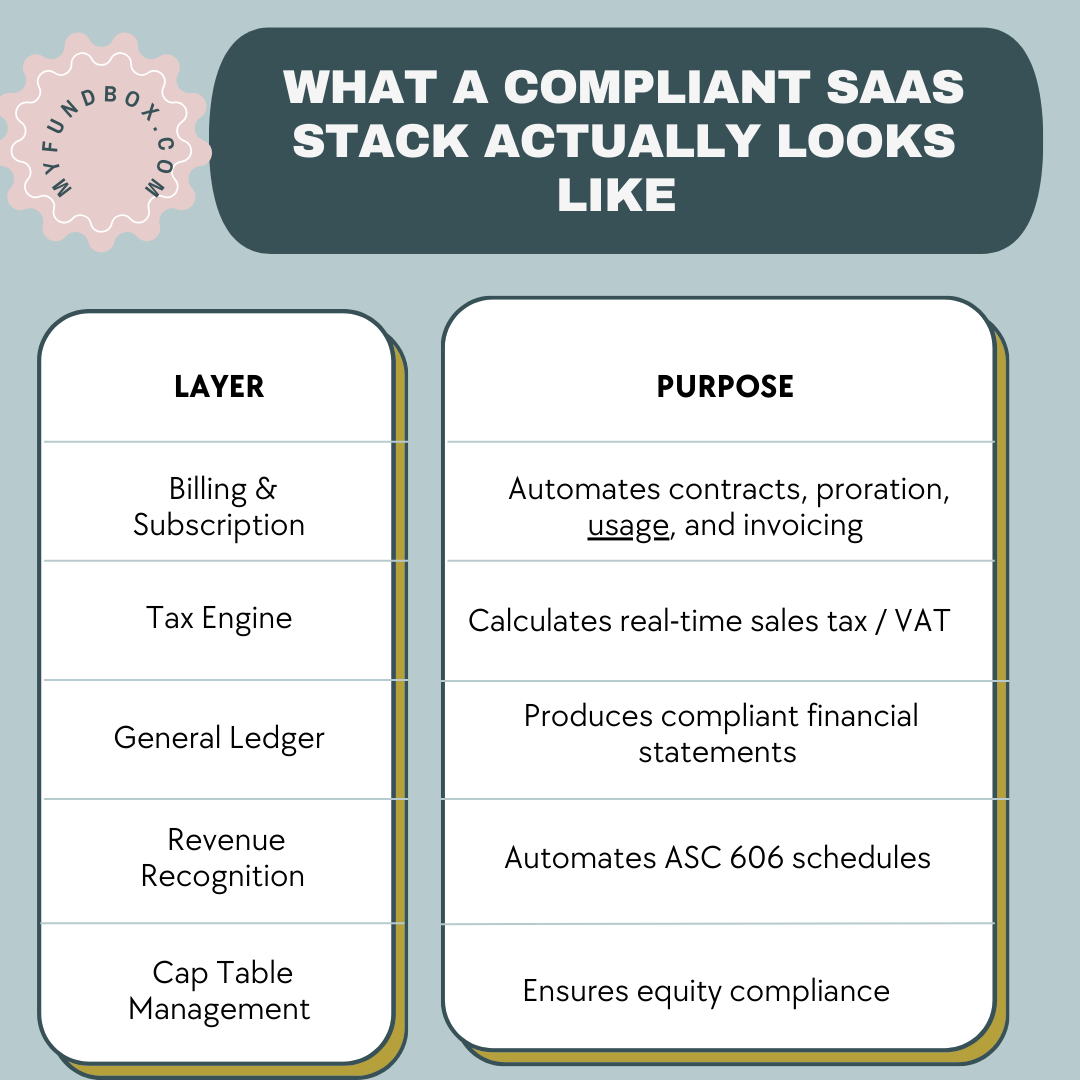
The mistake founders make is buying tools individually — without designing how data flows between them.
Compliance is architectural.
The Missing Layer Most Founders Overlook
Here’s what many SaaS companies get wrong:
They treat billing as a payment collection tool.
But billing is actually the control center of financial accuracy.
If your billing system:
Then compliance becomes operational — not reactive.
This is where a structured subscription management platform like MYFUNDBOX shifts the equation.
Instead of exporting data and correcting it later, your subscription, invoicing, retries, and reporting workflows are aligned from the start.
You move from:
Manual reconciliation → Automated sync
Reactive corrections → Preventative structure
Valuation risk → Diligence readiness
And when billing is architected correctly, everything downstream — accounting, tax, reporting — becomes cleaner.
Move from Reactive to Diligence-Ready
A compliant finance stack does three things:
If you are scaling toward $1M–$10M ARR, your billing infrastructure should not be creating accounting complexity.
It should be eliminating it.
MYFUNDBOX isn’t just about recurring billing.
It’s about building a finance foundation that scales with you — cleanly, transparently, and confidently.


.png)
.png)


.svg)


Predict and reduce customer churn.
Retain high-value clients. Skyrocket your MRR.

We are GDPR
Compliant

Data stored in
Frankfurt, EU


.png)


