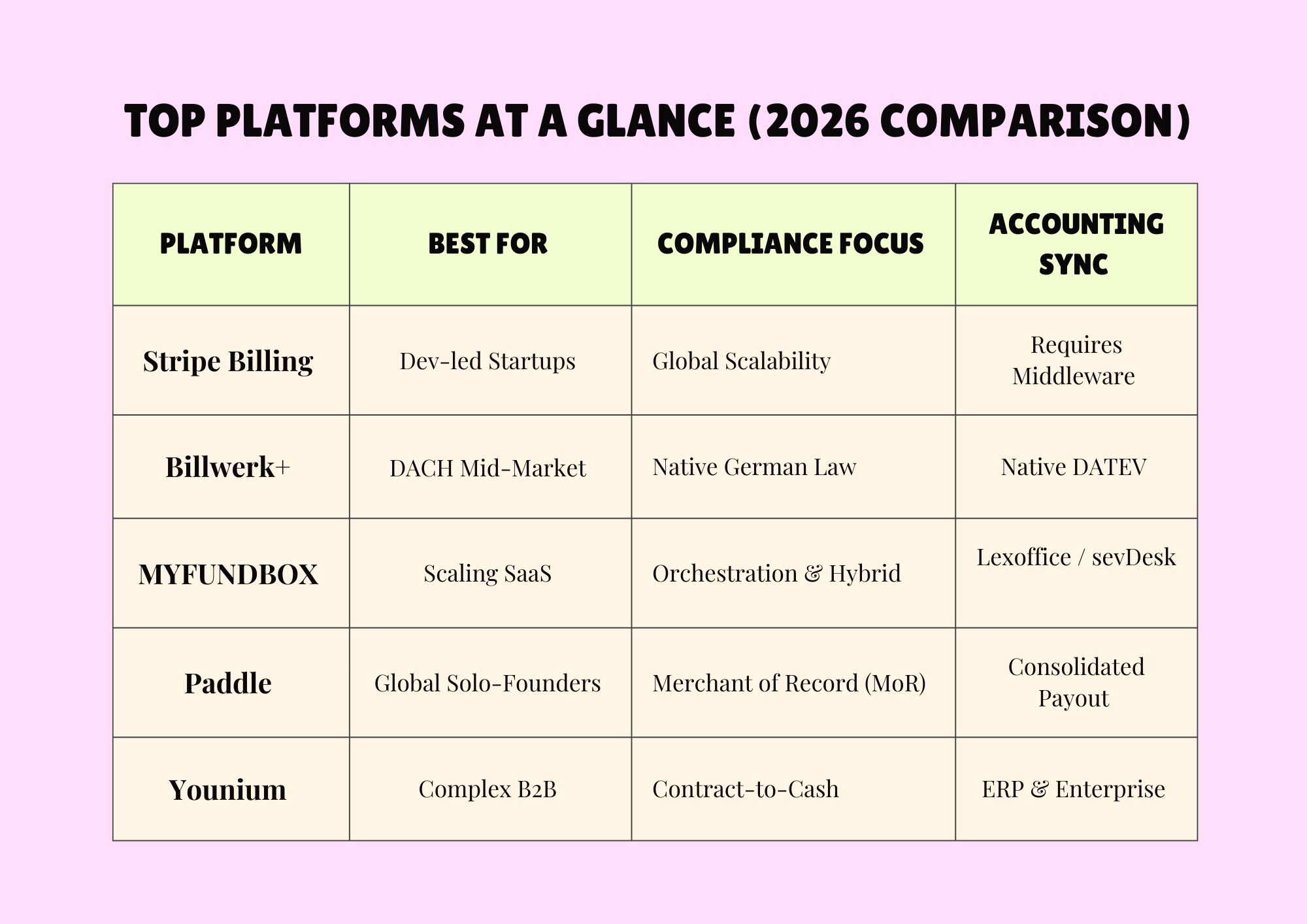
Stripe remains the default for developer-first teams. In 2026, Stripe has significantly matured its German footprint, moving beyond simple "tax calculation" into the realm of structured data.
2026 Update: Stripe now supports XRechnung and ZUGFeRD via its Tax and Invoicing modules, though full automation for German B2B often requires a partner app like Billit.
The Catch: While Stripe is powerful, it doesn't "speak DATEV" natively. You will likely need a connector (like Path-to-DATEV) to satisfy a German tax advisor.
Best for: Teams with engineering resources who want global reach.
Headquartered in Frankfurt, Billwerk+ is built specifically for the legal rigor of the German market. It is often the "safe choice" for companies targeting the Mittelstand.
Audit-Proof by Design: It handles GoBD-compliant archiving (Revisionssichere Archivierung) out of the box. Once an invoice is finalized, the audit trail is unbreakable.
The DATEV Edge: It offers the most robust native DATEV export, meaning your year-end audit is a "one-click" experience.
Best for: German B2B SaaS where legal certainty and "Made in Germany" data residency are sales arguments.
If you don't want to deal with German VAT filings, the Merchant of Record (MoR) model is your best friend. They sell the software for you.
Compliance Hack: Because Paddle is the seller of record, they shoulder the liability for e-invoicing mandates and VAT accuracy. You receive one clean payout.
Note: In 2026, ensure you use their updated "B2B Invoicing" flow to ensure your German customers receive the structured XML data they now legally require.
Best for: Founders who want to offload 90% of the administrative burden.
Before choosing a platform, ensure it checks these three boxes:
1. The E-Invoicing Transition
By January 2026, your business must be able to receive and process e-invoices (ZUGFeRD/XRechnung). While mandatory issuance for companies over €800k turnover begins Jan 1, 2027, 2026 is the year your B2B customers will start demanding structured data to automate their own workflows.
2. GoBD "Audit-Proof" Archiving
Simply saving a PDF to a folder is not enough. Your billing platform must ensure:
Immutability: Invoices cannot be changed after issuance.
Traceability: Every credit note and "Storno" must be linked to the original document.
3. The "Steuerberater" (Tax Advisor) Connection
In Germany, your accountant is your most important stakeholder. If your billing platform can’t export a DATEV-compatible CSV, you will pay for it in manual bookkeeping fees.
Conclusion: Which One Should You Choose?
If you have developers and want total control: Go with Stripe Billing.
If you want to focus on code and ignore tax laws: Choose Paddle.
If you sell to German Enterprises/Mittelstand:Billwerk+ is the clear winner.
If you need flexibility and use Lexoffice/sevDesk:MYFUNDBOX
is the sweet spot.
The right billing platform doesn't just process payments—it future-proofs your business against the tightening net of digital tax compliance in Germany.
Asra Anjum
Recent Blogs
How MYFUNDBOX Simplifies Complex German Tax-Compliant Billing How MYFUNDBOX Simplifies Complex German Tax-Compliant Billing



.png)




.png)
.png)


.svg)





.png)


